
Heavy Metal Summer School 2025 at SCK CEN
Heavy liquid metal (HLM) coolants offer new perspectives for the development of innovative nuclear systems for nuclear waste transmutation and energy production. The Belgian Nuclear Research Centre (SCK CEN) is working on the development of the HLM cooled MYRRHA accelerator driven system (ADS). MYRRHA will serve as an ADS demonstrator for transmutation, as an HLM reactor pilot plant and it will be used as an irradiation tool for research. With this, it is at the forefront of HLM nuclear technology worldwide.
During this summer school, participants will gain insight into the state-of-the-art research focused to the development of MYRRHA and other HLM-based nuclear systems. The summer school will cover several aspects of HLM technology that are essential for the engineering design and safety of nuclear systems.
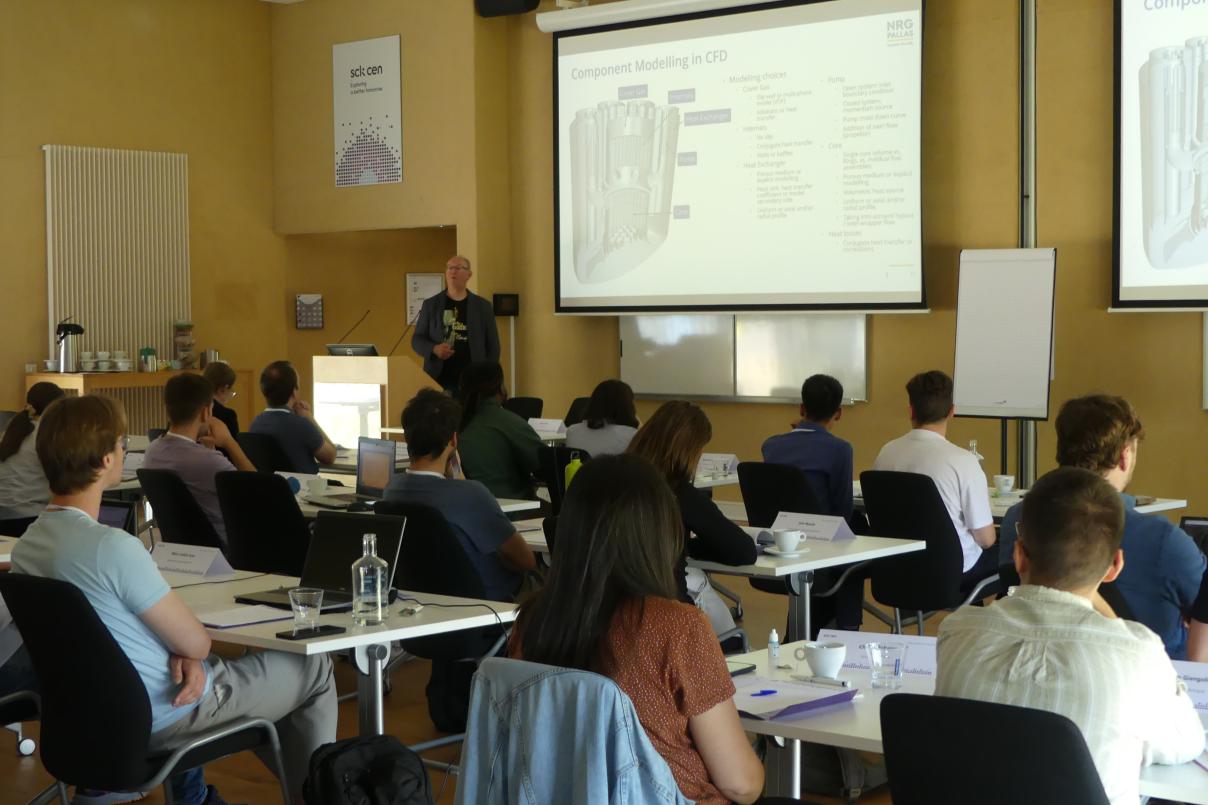
Experts from SCK CEN and other internationally renowned research organizations will give the lectures. They will cover the most advanced HLM-based nuclear systems and deal with the neutronics, chemical, thermal hydraulic and materials issues and challenges in instrumentation, safety and design. Complementary to the lectures, visits are foreseen to various experimental facilities that were constructed at SCK CEN in support of the MYRRHA project.
Throughout the course week, participants will have the opportunity to brainstorm on best practices and selections of technologies for HLM cooled nuclear systems in interactive sessions with the experts.
As a research center specializing in heavy liquid metal technology, it seems more than a coincidence that SCK CEN is neighbor to one of the most successful Heavy Metal festivals in the world: the Graspop Metal Meeting (GMM). The GMM begins when the HLM summer school ends. Each participant receives a free festival ticket for GMM for Friday June 20 (*), 2025 to enjoy metal and liquids at this unique festival.
SCK CEN reserves the right to cancel a training course or event (e.g. in case of low number of registrations).
The course is organized by SCK CEN in collaboration with the OECD NEA Nuclear Education Skills and Technology (NEST) Framework. This summer school is supported by the EC TRANSPARANT project (Technological Research Action Necessary for Safe PARtitioning And Nuclear Transmutation, HORIZON-EURATOM-2023-NRT-01, ref n° 101166386) and MYRRHA IVZW. Mobility grants for participants are also available via the ENEN2plus project (ref n° 101061677).
(*) Participation to the GMM festival is voluntary and at your own risk. Conditions of GMM on ticket apply. You are not entitled to exchange the ticket with SCK CEN nor claim the value hereof from SCK CEN. SCK CEN is not responsible for any damage or theft at GMM.
Topics
To set the frame, the motivation for HLM-based nuclear systems and the design of several of the most developed HLM facilities will be introduced. In addition, the link with accelerator technology for ADS systems and partitioning and transmutation fuels is made.
In a module on chemistry you will be introduced to the various sources of impurities in HLM and to methods for their purification, to oxygen monitoring and control systems, and to the chemistry of radioactive impurities.
In the module on materials you will learn to select materials for structural and functional components of reactors and get acquainted with irradiation damage processes and with liquid metal induced corrosion and its mitigation strategies.
The thermal hydraulics module will start from the fundamentals of heat transfer in liquid metals to provide insight in the thermal hydraulic phenomena occurring in the fuel assembly and primary system. Experimental and numerical tools for the system safety analysis will also be covered.
In the instrumentation module you will get an overview of measurement techniques that can be used in liquid metals.
Attention is also given to the socio-economic and ethical aspects of this technology.
Audience
The summer school is targeted to last year Master students in engineering, PhD students, post-docs and young professionals in the field.
Required Knowledge
Participants should have obtained a Master degree in physics or engineering (or be at the end of the last year).